Many web shops are considering an AI chat for customer service. There are plenty of ready-made services: Intercom Fin, Zendesk AI agents, Tidio Lyro, Gorgias and Freshdesk Freddy. They are good services. But they work outside the shop and learn mainly from help pages, URLs and uploaded files.
In a specialist shop the hard questions are not answered on help pages. At LedStore customers ask, for example, which driver they need, how long a strip can run from one feed, which profile suits a sauna and how to wire kitchen worktop lights. The answers are in the shop's own history: the e-mails and designs its sales staff have written over the years.
That is why KIDE's AI was built as part of the shop. It was built and trained first at LedStore, and every figure in this article comes from LedStore's production in November 2026.
A shop's most valuable knowledge is in its mailbox
LedStore's info@ mailbox held 97,230 messages from its whole history, 43.6 GB in total. On top of that the shop had 1,528 design tickets with floor plans, 2,800 products, and the blog and pages in eight languages. An external chat usually never sees material like this. None of the external services we compared says on its own pages that it learns from an old e-mail archive with attachments.
Years of mailbox also contain a lot of noise. So e-mail is sorted before anything is learned. A free rule run sorted every message: newsletters, ads, factory and supplier mass mail, automatic mail and off-topic mail out; customer mail with trade vocabulary in; the rest uncertain.
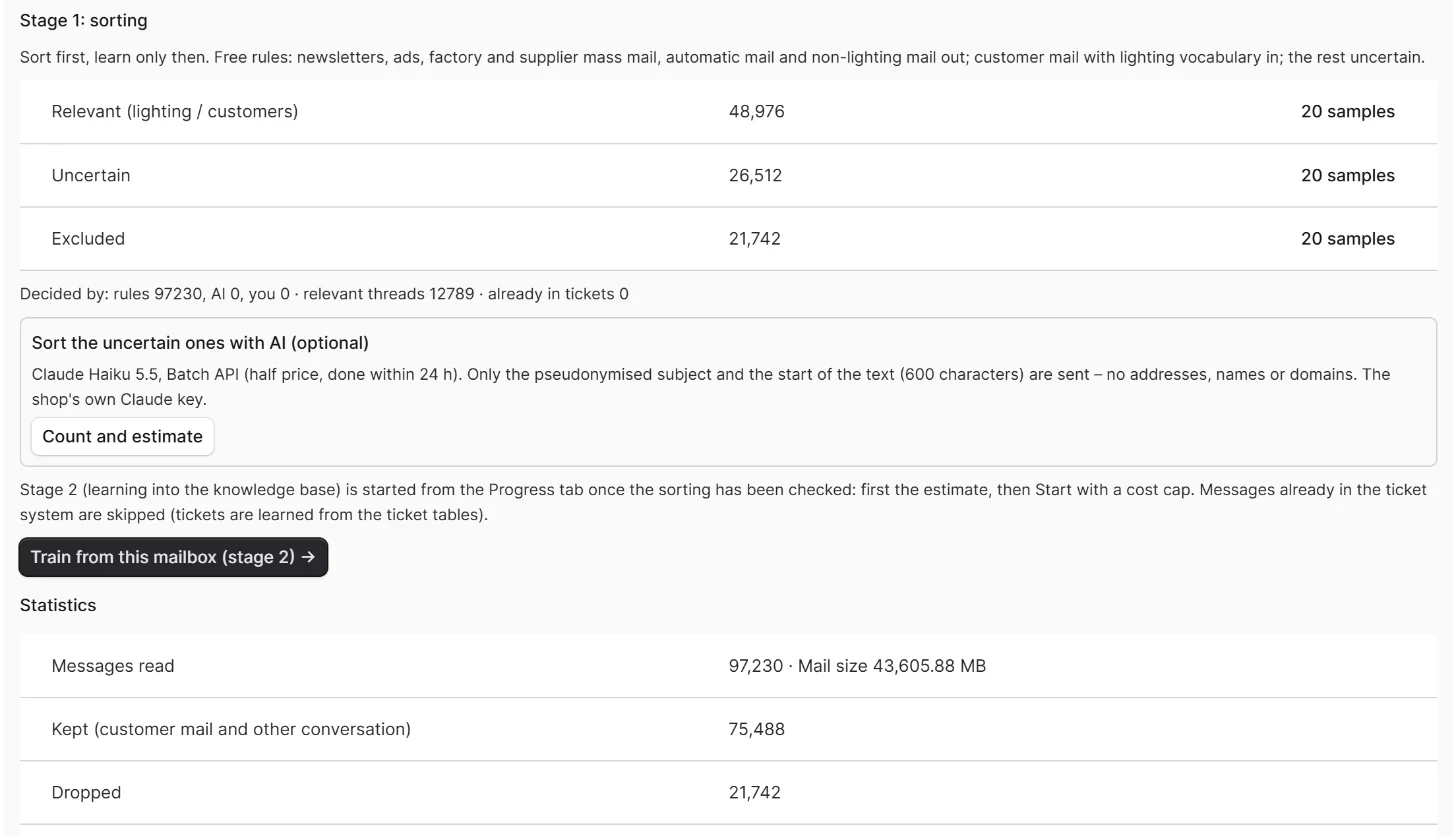
The result was 48,976 relevant, 26,512 uncertain and 21,742 excluded messages. The merchant sees 20 samples of each group before anything is learned. The uncertain ones can be sorted by a low-cost model from a separate button after a cost estimate, or left out.
Estimate first, then train
Every training run starts with Estimate. KIDE counts messages and attachments and estimates the price without sending anything. The run starts only when the merchant accepts a cost cap. A run can be paused and resumed, and progress and actual cost are visible all the time.
Only pseudonymised text is sent to the AI: names, addresses, phone numbers and e-mail addresses are replaced with tokens before sending. Raw messages are not stored in the shop database – only the refined knowledge and a source reference. Anthropic does not use API customers' data to train its models.
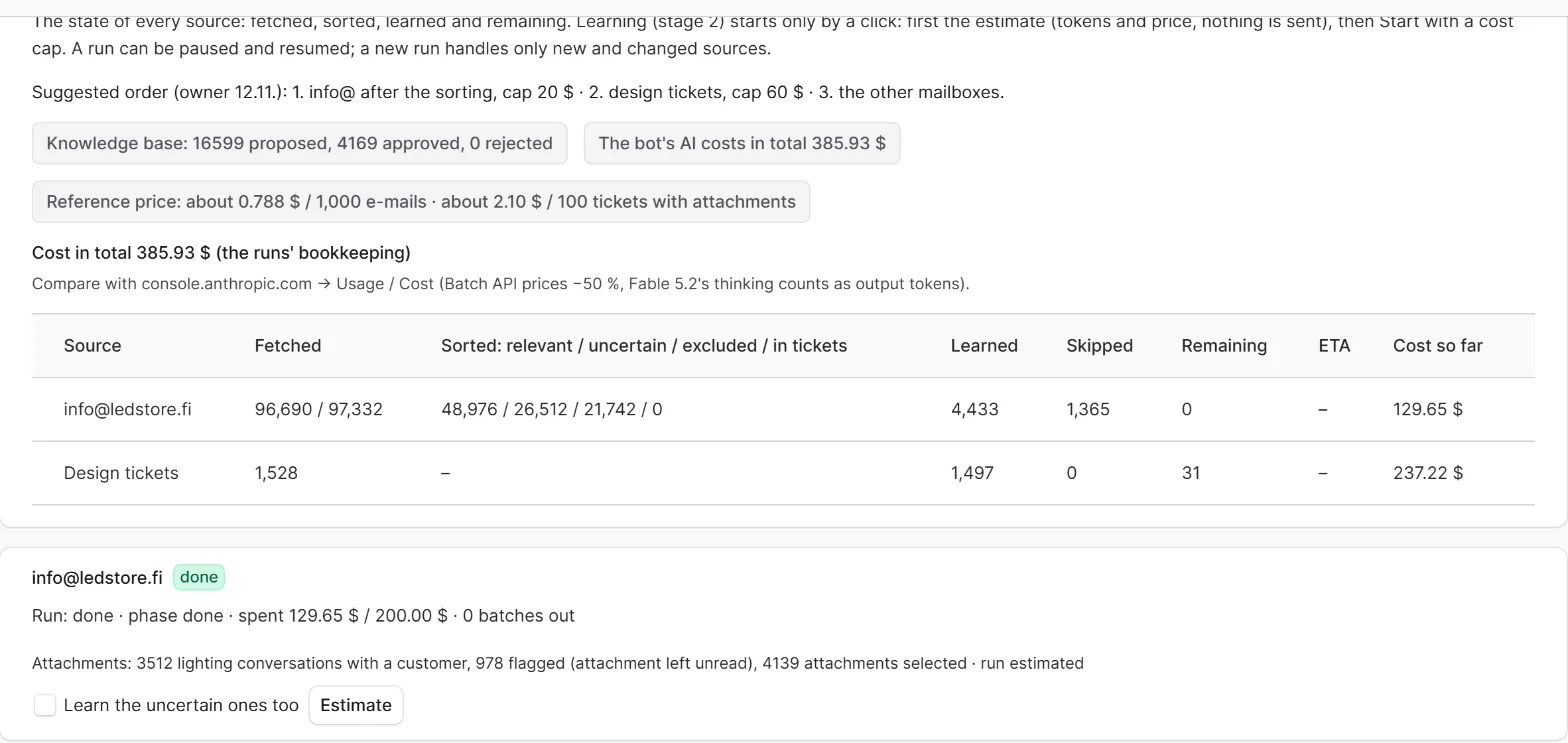
At LedStore, sorting the info@ mailbox and learning 4,433 customer conversations cost $129.65. Learning the design tickets with their floor plans cost $237.22. The total AI cost of the training was about $414.
What the AI learned
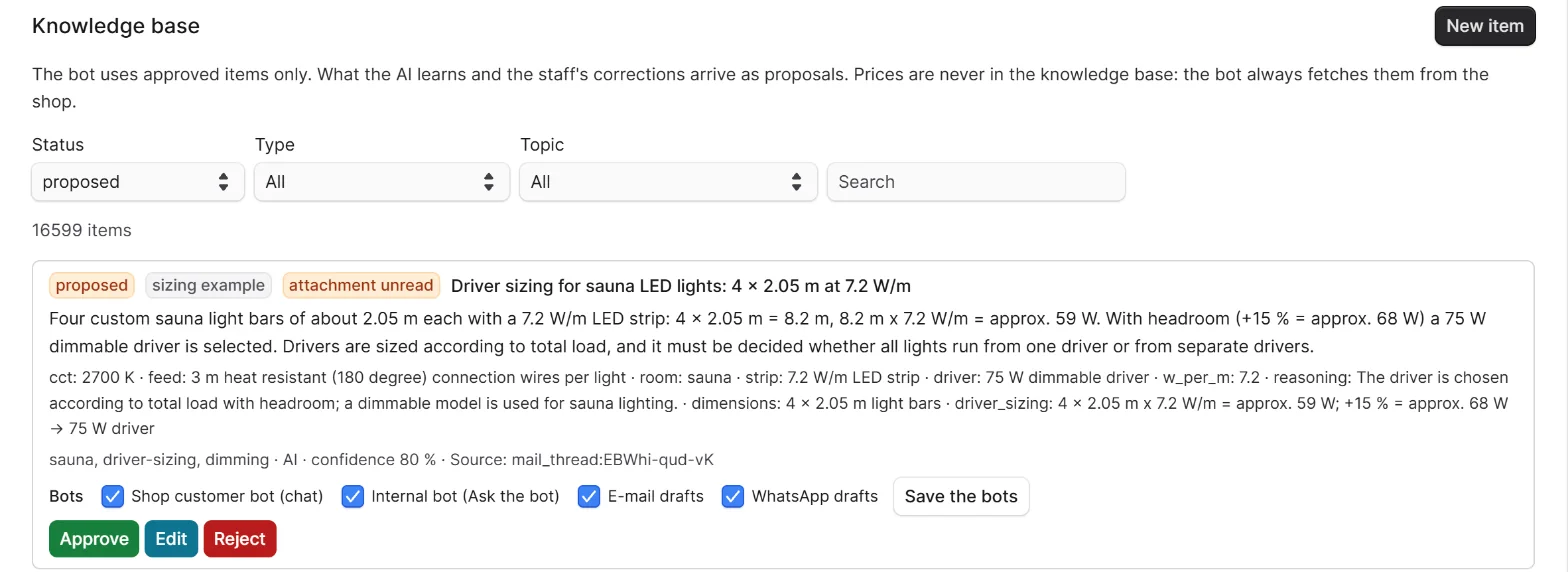
What is learned does not go inside the model. It goes into the shop's own knowledge base in the shop's database in Helsinki. In November 2026 LedStore's knowledge base held 20,926 items, 4,169 of them approved: 6,273 product tips, 4,931 question–answer pairs, 4,795 design solutions, 3,978 rules and 949 sizing examples.
Every item has a source and a state: proposed, approved or outdated. The bot uses approved items only. The merchant approves, edits or rejects the proposals like the Daily tasks.
The shop is the source, not a memory
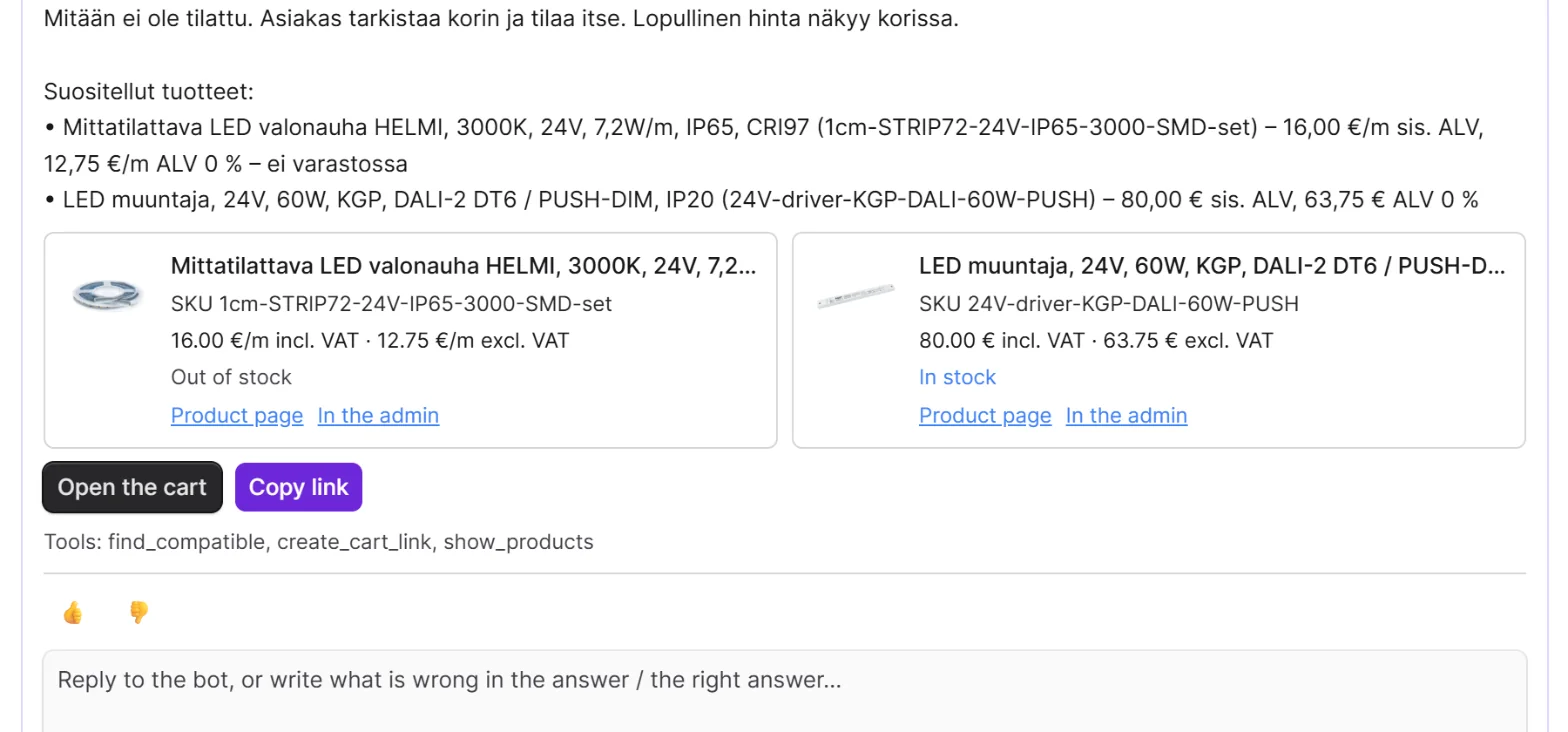
Prices, stock and products are never stored in the AI's memory. When a customer asks, the bot fetches compatible products, prices, stock and delivery times from the shop right then. Before an answer is shown, the software checks every product and price mentioned against the shop. An invented product or a wrong price is blocked by code, not just by an instruction.
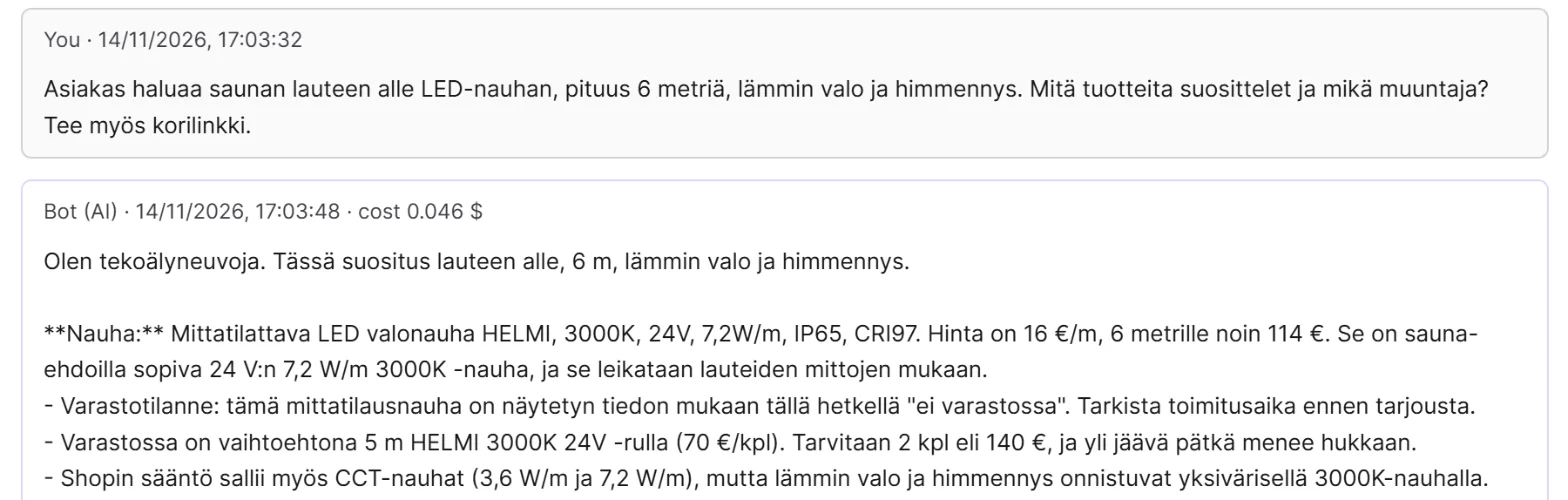
The bot can also create a cart link and a quote draft in the shop's quote tool. Every answer has thumbs and a "what is wrong in this answer" field. A correction goes into the knowledge base as a proposal, and the bot uses it in the next answer.
E-mail: replies in your own mailbox, not a separate helpdesk
With external services, e-mail is routed into the vendor's own helpdesk. None of the services we compared says it writes reply drafts into the merchant's own mailbox.
KIDE's AI reads the incoming message and writes a reply in the shop's style straight into the mailbox's Drafts folder, in the right thread. The salesperson opens the draft in their own e-mail program, checks it and sends it. A sent reply is stored in the mail server's Sent folder like any other.
- Per-mailbox mode: off, drafts, semi-automatic or fully automatic.
- Always a draft: complaints, returns, refunds, payments and legal matters, even in fully automatic mode.
- Safety limits: automatically sent mail has a daily cap, a 5-minute undo window and an AI disclosure. All automatic replies can be stopped with one button.
- Quality is measured: how many drafts were sent unchanged and how many edited.
What it costs
External services usually charge per conversation or resolution, $0.50–2.00 each, often plus helpdesk seats at $19–132 per person per month. KIDE's AI uses the shop's own Claude key. Measured at LedStore, a chat costs about $0.01–0.05 per conversation and an e-mail draft $0.03–0.06.
An example: 1,000 customer chats a month. With external per-resolution pricing ($0.99–2.00 per resolved conversation) that is about $990–2,000 a month before helpdesk seats. In KIDE the AI cost of the same volume is about $10–50, based on LedStore's measurements.
KIDE adds no margin to AI costs. Each channel has a daily cap; when it is reached, the bot hands the customer to a person and the cost stops growing. Your own AI is available with the Growth and Enterprise plans. It costs €99 a month plus AI usage, and onboarding costs €1,000–5,000 one-off, depending on the amount and quality of the material.
External services' prices and features: the vendors' own pricing and help pages, checked 14 Nov 2026. Prices in USD excl. VAT and subject to change.
Where LedStore is now
In November 2026 the knowledge base and the staff bot are in use. E-mail replies are rolled out one mailbox at a time starting with info@, as drafts first. The customer chat opens once every lighting-related mailbox has been learned.
Retraining handles only new and changed sources: new e-mails, new tickets, changed products and new blog posts. Approved knowledge stays. The bot gets better every week without starting from scratch.
In short: the difference
- What it learns from: an external chat learns mainly from help pages. Your own AI learns from the shop's whole history: e-mails with attachments, design tickets with floor plans, products, blog, FAQ and staff corrections.
- Products and prices: your own AI reads them from the shop at answer time, and every product and price mentioned is checked by code.
- E-mail: the reply is written into the shop's own mailbox in the right thread, not into a separate helpdesk.
- Cost: AI usage on the shop's own key with no margin, and every channel has a daily cap.
- Control: the merchant chooses the sources, approves what is learned and decides how automatic each mailbox is.
All the details, channels, the comparison table and the example calculations are on the Your own AI page.
How onboarding works
- Sources and mailboxes are connected and the sorting rules are tuned to the shop's trade.
- The sorting samples are reviewed together with the merchant.
- Training runs with cost caps. The exact price is calculated first with Estimate, and the AI costs go to the shop's own key.
- The first knowledge base proposals are reviewed and the approval routine is agreed.
- The shop's own cases are tested (delivery, returns, compatibility, B2B), then the chat, e-mail replies and the staff bot go live.
Images: the KIDE admin from LedStore's production in November 2026 (admin language English). No personal data is shown.